
NOTES FOR UGC YOGA NET JRF
History of Yoga – For UGC Yoga Net Jrf Exam
Origin of Yoga
The earliest conceptual foundations of Yoga are found not only within Indian intellectual traditions but also in the oldest extant literary corpus of humanity—the Vedas. The Ṛgveda, particularly its first and ninth Maṇḍalas, offers subtle indications that early Vedic society was initially oriented toward material aspirations and sensory enjoyment. During this phase, human engagement with the Divine primarily took the form of hymns, charitable acts, and sacrificial rituals, performed with the intention of attaining worldly prosperity, health, and well-being.
At its core, however, the central philosophical pursuit of the Vedic tradition is Brahma-jñāna, the knowledge of Ultimate Reality. Ritualistic practices were not ends in themselves but functioned as preparatory disciplines, guiding individuals toward inner refinement and higher realization. Vedic teachings were designed to serve individuals at various levels of psychological and spiritual maturity, including those whose minds were deeply entangled in worldly attachments and lacked inner purity. Such individuals were considered unfit for direct reception of transcendental knowledge.
To address this limitation, the Vedas prescribed karmic disciplines such as yajña (sacrifice), japa (sacred recitation), dāna (charity), and other ritual observances, aimed at purifying the mind (citta-śuddhi). Once mental clarity and receptivity were established, the seeker was gradually led away from ritual dependence and directed toward contemplation of the Supreme Reality. This philosophical transition is clearly reflected in the following Ṛgvedic mantra:
'ऋचो अक्षरे परमे व्योम समासतेः।’ — Ṛgveda, 1/64/39
This mantra conveys that the imperishable Brahman, established in the Supreme Cosmic Space (Param Vyoma), is the foundational reality in which the Vedic hymns and all cosmic deities subsist. For one who remains unaware of this eternal principle, the hymns retain only verbal significance and lack transformative value. Conversely, the individual who realizes Akṣara Brahman alone is truly qualified to engage in authentic discourse on Brahman. Hence, the Vedas ultimately affirm that true Vedic knowledge is inseparable from the realization of Brahman, and only a knower of Brahman can rightfully be called a Veda-knower. From this standpoint, it becomes evident that the origins of Yogic wisdom are deeply embedded within the Vedic tradition itself.
At the same time, several scholars, supported by modern archaeological investigations, propose that Yoga was already in practice during the Indus Valley Civilization. Excavations at sites such as Mohenjo-daro have yielded religious artifacts, including a three-faced male figure seated in a yogic posture, strongly suggesting the presence of systematic yogic thought and meditative practices during that period.
Contemporary research further suggests that the Indus Valley Civilization was not isolated from Vedic culture but rather reflected a Vedic-influenced cultural continuum. It represented a distinctive phase of Indian civilization, characterized by a synthesized cultural framework that integrated spiritual, philosophical, and social elements in a highly developed form.
Origins of Yoga in the Vedic Period
The origin of Yoga can be traced to the Vedic period, particularly to the Ṛgveda, which provides the earliest references to yogic concepts in symbolic and philosophical form. In the Vedic context, Yoga was primarily concerned with spiritual discipline rather than physical practice. Key concepts such as tapas (austerity), dhyāna (meditative contemplation), brahmavidyā (knowledge of the Absolute), and yajña (sacrificial discipline) formed the foundation of yogic practice. The Vedas emphasize mental purification and control of the senses as prerequisites for higher knowledge. Yoga during this period aimed at realization of Brahman and liberation from ignorance, establishing Yoga as a means to transcend material existence and attain spiritual enlightenment.
2. Yoga as a Means to Brahma-jñāna
In the Vedic and early Upaniṣadic tradition, Yoga was regarded as a systematic means for the attainment of Brahma-jñāna, the highest knowledge of ultimate reality. Yogic discipline functioned as an inward journey from ritual action to contemplative realization. Practices such as tapas, śraddhā, dhyāna, and self-restraint purified the antaḥkaraṇa, enabling the aspirant to transcend empirical knowledge. Rituals and sacrifices were not ends in themselves but preparatory aids for mental refinement. The culmination of Yoga was the direct experiential realization of Brahman, leading to liberation (mokṣa) from ignorance and cyclical existence, thus establishing Yoga as a spiritual epistemology rather than a merely physical discipline.
3. Yogic Elements in the Upaniṣads
The Upaniṣads represent a significant advancement in yogic philosophy by shifting emphasis from external ritualism to internal realization. They introduce systematic practices of meditation (dhyāna), self-inquiry (ātma-vicāra), and disciplined control of the mind and senses. Fundamental yogic concepts such as prāṇa, nāḍī, manas, and the unity of ātman and brahman are elaborated with philosophical clarity. Texts like the Kaṭha, Śvetāśvatara, and Muṇḍaka Upaniṣads provide early formulations of concentration, withdrawal, and contemplative absorption, which later became core components of classical Yoga systems.
4. Pre-Vedic and Indus Valley Evidence
Archaeological discoveries from the Indus Valley Civilization, particularly seals from sites such as Mohenjo-daro and Harappa, depict human figures seated in stable, meditative postures often identified as proto-yogic. The famous “Pashupati seal,” portraying a horned deity in a yogic posture, indicates the presence of ascetic and contemplative traditions during the pre-Vedic period. These findings suggest that yogic discipline was not a sudden development of the Vedic age but had deep cultural roots, later systematized and philosophically refined within Vedic and post-Vedic literature.
5. Hiraṇyagarbha as the Primordial Teacher of Yoga
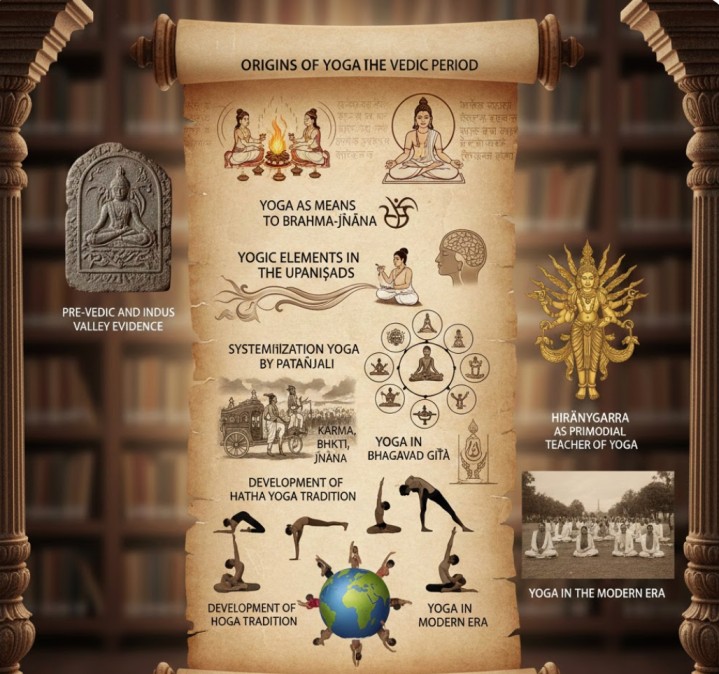
Ancient scriptures such as the Yājñavalkya Smṛti and the Mahābhārata identify Hiraṇyagarbha as the original teacher of Yoga, establishing Yoga as a divine and timeless science.
6. Systematization of Yoga by Patañjali
Sage Patañjali, often regarded as the compiler of classical Yoga, codified centuries of yogic practices and philosophy into the Yoga Sūtras. His work provides a structured approach to attaining spiritual liberation (kaivalya) through the eightfold path known as Aṣṭāṅga Yoga, which includes Yama (ethical restraints), Niyama (observances), Āsana (postures), Prāṇāyāma (breath control), Pratyāhāra (withdrawal of senses), Dhāraṇā (concentration), Dhyāna (meditation), and Samādhi (absorption). Patañjali emphasized disciplined practice (abhyāsa) and detachment (vairāgya) as essential for mental purification, self-realization, and the attainment of enduring inner peace. His systematic presentation remains foundational in both classical and contemporary yogic study.
7. Yoga in the Bhagavad Gītā
The Bhagavad Gītā presents Yoga not merely as a meditative practice but as a practical philosophy applicable to all aspects of life. It emphasizes Karma Yoga (selfless action), Bhakti Yoga (devotion), and Jñāna Yoga (knowledge and discernment), offering multiple paths tailored to individual temperament and duties. By integrating these forms, the Gītā makes Yoga accessible to both householders and renunciates, promoting ethical living, spiritual growth, and detachment from outcomes. Central concepts include equanimity (samatā), self-discipline, and surrender to the divine, highlighting a balanced approach that harmonizes worldly responsibilities with spiritual realization.
8. Development of Haṭha Yoga Tradition
Haṭha Yoga, which developed during the medieval period, emphasized the integration of body and mind through systematic physical and energetic practices. Its core components include āsanas (postures) for bodily strength and flexibility, prāṇāyāma (breath control) for regulating vital energy, and śatkarmas (purification techniques) to cleanse the body and subtle channels (nāḍīs). Haṭha Yoga was designed to prepare practitioners for higher spiritual pursuits, including meditation (dhyāna) and samādhi. Texts like the Haṭha Yoga Pradīpikā and Gheraṇḍa Saṃhitā codified these practices, marking a significant evolution in the experiential and practical dimensions of Yoga.
9. Yoga in the Modern Era
In the nineteenth and twentieth centuries, Indian yogis such as Swami Vivekananda, Sri Aurobindo, and Tirumalai Krishnamacharya revitalized and globalized Yoga, presenting it as an integrated system addressing body, mind, and spirit. Modern Yoga emphasized physical health through āsanas, mental clarity through Practice Questions – History of Yoga